Admittedly, I am jumping ahead a bit. To get from Finnmark to the start of the Lofoten Islands I drove about 450 kilometers (280 miles) over two days, camping at Solbakken Camping. I also made a few town stops where I unfolded my foldable bike and woke my body up.
I was eager to begin this next phase and had allocated an entire week to slow down, hike, and explore this 300 km (186 miles) stretch of land. However, I was concerned about all the people I might encounter. The Lofoten Islands are one of the most visited areas in Norway and since I had really not dealt with any sort of crowds up until that point, I was hesitant about what I might experience. Admittedly, I also doubted that it could be more spectacular than what I had already experienced within the Arctic Circle. How would that even be possible?
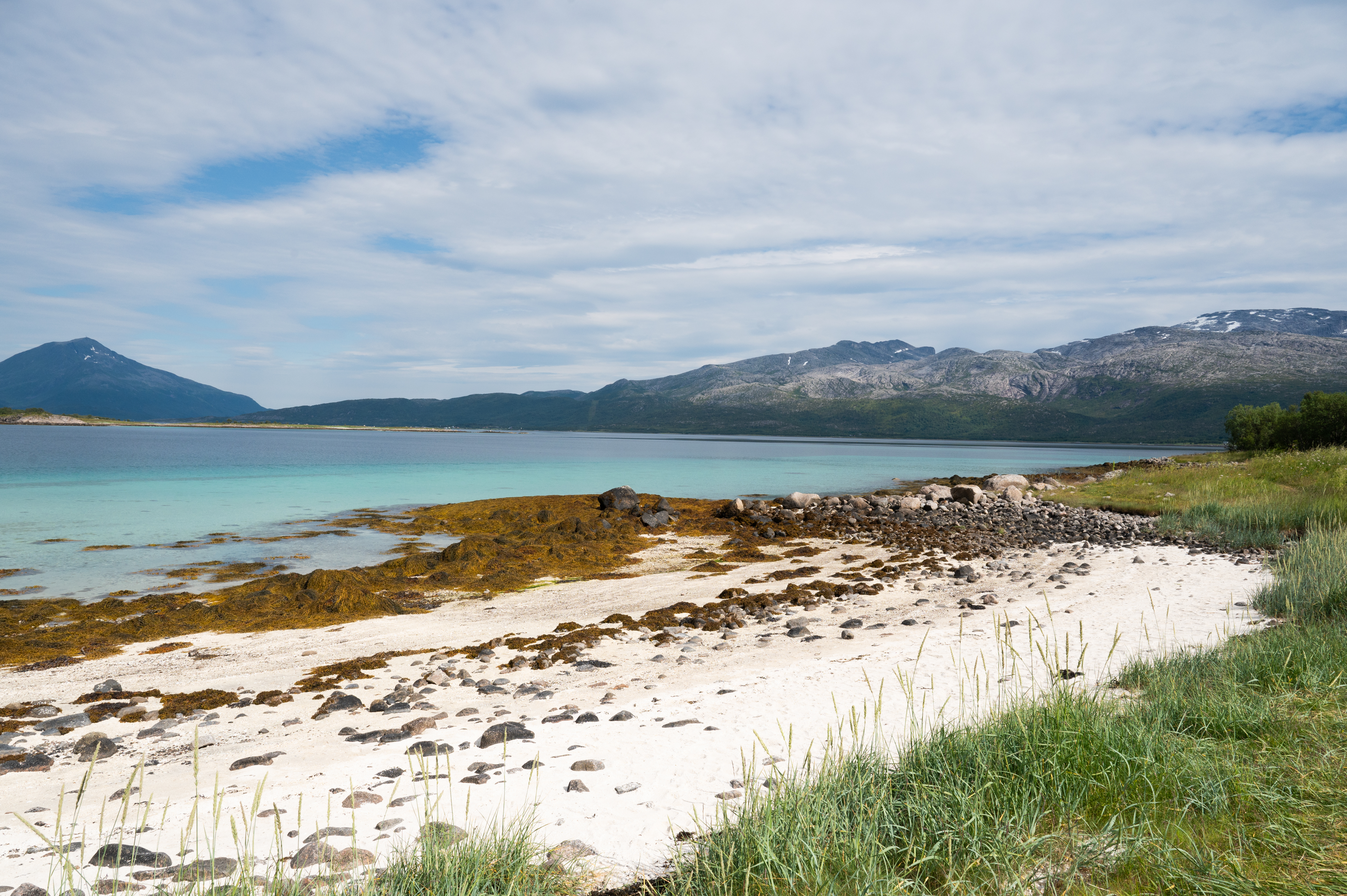
It was. Once I arrived, I knew exactly why so many flock to this area of extreme beauty. I was immediately transported into a Norway that boasted all I had seen and loved thus far but for extra fun white sand beaches and vibrant aqua water were also sprinkled in. Once again I was left breathless at the sites. And extremely glad I had a week to explore.
I had loosely planned some hiking ventures. I had spent the previous couple of evenings studying 16 Stunning Hikes in Lofoten knowing that I would have to ultimately pick just a few. I highlighted all those I was most interested in and determined the final decisions would be based on where I ended up camping, when I felt like hiking, and what my energy level was that day. Essentially, I would play it by ear.

Having already passed beyond the first few hikes I crossed those off. I was most interested in continuing on my way and settling into a campground located deeper into the islands. And there were many to choose from! The first one that caught my eye on the map had very bad reviews, warning of an irritable and xenophobic owner. Yikes! Seems like perhaps the wrong profession was chosen. Despite that, I played with staying there anyway because it was so conveniently located to Matmora, a hike on the top of my mental list as one of the least crowded and most scenic. I ultimately determined that I did not need the bad energy of an angry local tainting my experience, nor did I wish to support such a person’s business. Instead, I found a campground very close to where I currently was. It would add an hour’s drive to the trailhead in the morning but since I had nothing but time, what difference did that make? Plus it had great reviews!

Soon thereafter I arrived at Camping Raften set along the scenic Tengelfjord. I was so impressed with this campground that I would end up spending two nights there, a first and only during my time in Norway.
What I loved so much about Camping Raften was its scenic setting perched at the edge of the fjord and its price. It was the cheapest campground I had yet to find, to my great surprise being in such a touristy area of Norway. It cost 250 Nok ($25 USD) per night. For that, I got a hot shower and an electric hookup for my van.
After my shower and dinner, I settled in and caught up with friends back in Portland over the phone. Another perfect day in Norway.
Lessons from: The Lofoten Islands
- Google reviews is a great way to investigate campgrounds- amenities and price.
- The cell service in Norway is exceptional. You can expect to be able to stay connected with those at home while you travel.
- The eastern section of the Lofoten Islands is not nearly as touristy and crowded as the western.
Something interesting: Right to roam laws in Norway
Because outdoor recreation is a major part of the national identity, access to nature is protected by law. Allemannsretten, meaning “everyman’s right,” is a law in Norway that allows everyone to roam free (and tent camp) on uncultivated land. Sometimes referred to as “unfenced land”. This includes most shores, bogs, forests, and mountains. In 1957, this law was enshrined in the Outdoor Recreation Act. Leaving as light a footprint as possible is expected.
Areas not included would be cultivated land- pastures, gardens, private meadows, and plowed fields- whether fenced or not. There is one interesting exception to this, though. From October 15th to April 30th, it is permissible to access cultivated fields and meadows as the ground is frozen or covered with snow. You must camp at least 150 meters away from any inhabited house or cabin. And if you want to stay for more than two nights in the same place, you must get the landowner’s permission, unless in a very remote area.
There are areas in the more popular tourist destinations (ie: The Lofoten Islands) where there are restrictions in place, typically during the summer months. Despite this, I did see on many occasions during my week in the Lofoten Islands, where there were tents on hillsides surrounding very popular towns, like Henningsvær. So you must look for signs or ask a local to know for sure!
Info from: Visit Norway- The Right to Roam
A look behind the curtain.
Okay, there was an aspect of Norway that I did have a hard time with. It can’t all be perfect! But there was also a silver lining to this.
One of the towns I stopped at to explore via bike on my journey from Norkapp to the Lofoten Islands was Bardufoss. It was here that I first experienced the extent of Norwegian’s seeming aversion to interacting with strangers when no reason was being presented to them.
On this day, I crossed paths with a handful of Norwegians, all of whom were alone. As an American, I am accustomed to making eye contact with strangers and offering a friendly smile, maybe even saying ‘hello!’. This behavior gets you nowhere in Norway.
Wanting to fit in, I quickly began to follow suit when I knew I was in the midst of locals (this was strictly a Scandinavian affair- those from other parts of Europe behave as Americans do with strangers). When in Rome, after all! But I did find it challenging. I experienced a sinking feeling as if I did not even exist in a stranger’s eyes. Like I had been covered in an invisibility cloak. Like I was not relevant. Also, I felt I was being rude as my cultural practices are hard-wired into my behavior. But, I also took heart knowing from experience that if I were to verbally initiate communication with a question, the stranger’s friendliness and openness would immediately come forth.
I can’t say that I ever got used to this, but I did get more comfortable with it and, over time, started to see and feel the benefits that came along with this cultural practice. No small talk. Kinda nice! Also, it felt there was a strong sense of acceptance, a sense that “I am doing my thing, you are doing your thing, I am not judging, nor do I even care”. I found this aspect incredibly liberating. Ultimately, I learned that avoiding eye contact is rooted in not wanting to disturb people unnecessarily. Hard to find fault in that!



 She Simply Wanders
Leave a comment